by Darpan Sachdeva
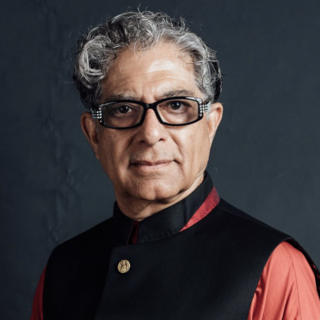
And the ancient wisdom that could set every entrepreneur free.
I’ve been thinking about identity lately. Not the kind you put on LinkedIn or the carefully curated version you present to investors, but the deeper question that keeps me awake midnight when the dopamine hits from another business win start to fade. Who am I when nobody’s watching? Who am I when the metrics don’t matter? Who am I beyond the avatar I’ve built?
This question hit me like a freight train recently when I encountered the profound wisdom of Deepak Chopra, a man who has spent over three decades studying the intersection of consciousness and human potential. At 76, having written 93 books and influenced millions, he shared something that completely shifted my perspective on success, purpose, and what it truly means to build a meaningful life.
The conversation wasn’t about hustle culture or exit strategies. It wasn’t about growth hacking or scaling to eight figures. Instead, it was about something far more fundamental and, frankly, far more frightening for someone like me who has built their entire identity around being “the entrepreneur.”
The Great Identity Trap
Here’s what I’ve discovered about us entrepreneurs: we’re masters at creating avatars. We become the founder, the CEO, the disruptor, the innovator. We curate our LinkedIn profiles, craft our origin stories, and slowly but surely, we start believing that we ARE these roles we play. But what happens when that identity becomes a prison?
Chopra talks about what he calls the “socially induced hallucination” of the separate self. In business terms, this is the moment when you stop asking “What problem am I solving?” and start asking “How do I maintain this image I’ve created?” It’s when your net worth becomes confused with your self-worth, and your company’s success becomes the sole measure of your value as a human being.
I’ve seen this happen to brilliant entrepreneurs around me. They achieve everything they thought they wanted, yet they’re miserable. They’ve built successful companies but lost themselves in the process. They’re making millions but can’t remember the last time they felt genuinely joyful about anything.
The problem isn’t success itself. The problem is mistaking the avatar for the person behind it.
The Creativity Antidote
But here’s where it gets interesting for those of us building businesses. Chopra revealed something profound about creativity that completely reframes how we should approach entrepreneurship. He said that creativity is the opposite of determinism. If you don’t want to be a biological robot or an algorithm, you need to embrace fundamental creativity.
Not the shallow innovation of launching iPhone 13 instead of iPhone 12 with a better camera. Real creativity. The kind that involves what he calls “a death and resurrection” – a death of old context, meaning, and story, and the birth of something genuinely original.
Think about the entrepreneurs who’ve truly changed the world. Steve Jobs didn’t just iterate on existing computers; he reimagined what a computer could be. Musk didn’t just improve cars; he redefined transportation itself. They didn’t just optimize within existing paradigms; they shattered them entirely.
This kind of breakthrough creativity requires something most of us entrepreneurs are terrible at: stillness. Taking time to be unoccupied. To sit with uncertainty. To resist the constant urge to do, do, do and instead learn how to simply be.
The Questions That Change Everything
In our relentless pursuit of growth and scale, we forget to ask the most fundamental questions. Chopra suggests we ask ourselves daily: Who am I? What do I want? What is my purpose? What am I grateful for? And perhaps most importantly, who am I without these constructs I’ve built around myself?
These aren’t abstract philosophical questions for monks on mountaintops. These are the questions that separate entrepreneurs who build sustainable, meaningful businesses from those who burn out after their third startup.
When I started really examining these questions in my own life, I realized I had been so focused on building my business that I had forgotten to build myself. I was optimizing for metrics that, ultimately, meant nothing if I lost touch with why I started this journey in the first place.
The Suffering Equation
Here’s something that struck me deeply about Chopra’s perspective on human suffering and how it applies to entrepreneurship. He identifies five core causes of suffering: not knowing who we truly are, not knowing the nature of reality, clinging to experiences that are fundamentally temporary, confusing ourselves with our ego identity, and fearing death.
In business terms, this translates to: getting so caught up in your founder identity that you lose sight of your authentic self, believing that external validation defines your worth, clinging desperately to wins and wins alike, building your entire sense of self around your business success, and living in constant fear of failure.
The antidote isn’t what you might expect. It’s not working harder or building bigger. It’s learning to observe your thoughts and experiences without being defined by them. It’s understanding that you are not your last funding round, your monthly recurring revenue, or your exit valuation. You are the awareness in which all these experiences happen.
The Real Success Formula
Chopra shared a fascinating equation for happiness that every entrepreneur should memorize:
H = S + C + V.
Happiness equals your Set point (determined by how you naturally view situations as opportunities or threats), plus your Conditions of living (which surprisingly only accounts for 10% of your daily happiness, even if you win the lottery), plus your Voluntary choices.
That last part is crucial. The choices we make daily account for 40% of our happiness experience. And there are two types of choices: those made for personal pleasure (which provide temporary satisfaction) and those made for fulfillment through meaning, purpose, and making others happy through genuine attention, appreciation, and acceptance.
As entrepreneurs, we often get addicted to the dopamine hits of personal pleasure – the funding announcements, the press coverage, the vanity metrics. But sustainable fulfillment comes from the deeper work of creating genuine value for others while staying connected to our authentic purpose.
Breaking Free from the Avatar War
The most liberating insight from my exploration of Chopra’s wisdom is this: you don’t have to play the avatar game. You don’t have to engage in what he calls the “battle between avatars” that dominates so much of entrepreneurial culture – the constant comparison, the competition for attention, the endless pursuit of external validation.
Instead, you can choose creativity. You can choose presence. You can choose to build your business from a place of genuine service rather than ego satisfaction. You can choose to measure success not just by financial metrics but by the quality of your relationships, the depth of your purpose, and your ability to remain connected to wonder and joy even in the midst of building something meaningful.
The Path Forward
This doesn’t mean abandoning ambition or settling for mediocrity. It means recognizing that your greatest competitive advantage as an entrepreneur isn’t your strategy or your funding or your team – it’s your ability to remain creatively connected to source while building something that matters.
It means taking time daily to step away from the doing and reconnect with your being. It means asking deeper questions about why you’re building what you’re building. It means having the courage to pivot not just your business model but your entire relationship with success itself.

Most importantly, it means remembering that you are not your avatar. You are something far more interesting, far more creative, and far more capable of making a real difference in the world than any professional identity could ever contain.
The avatar is just the costume. The real you – the aware, creative, purposeful you – is what the world actually needs.
 Darpan Sachdeva is the CEO and Founder of Nobelthoughts.com. Driven by a profound dedication to Entrepreneurship, Self-development, and Success over an extended period, Darpan initiated his website with the aim of enlightening and motivating individuals globally who share similar aspirations. His mission is to encourage like-minded individuals to consistently pursue success, irrespective of their circumstances, perpetually moving forward, maintaining resilience, and extracting valuable lessons from every challenge.