by Darpan Sachdeva
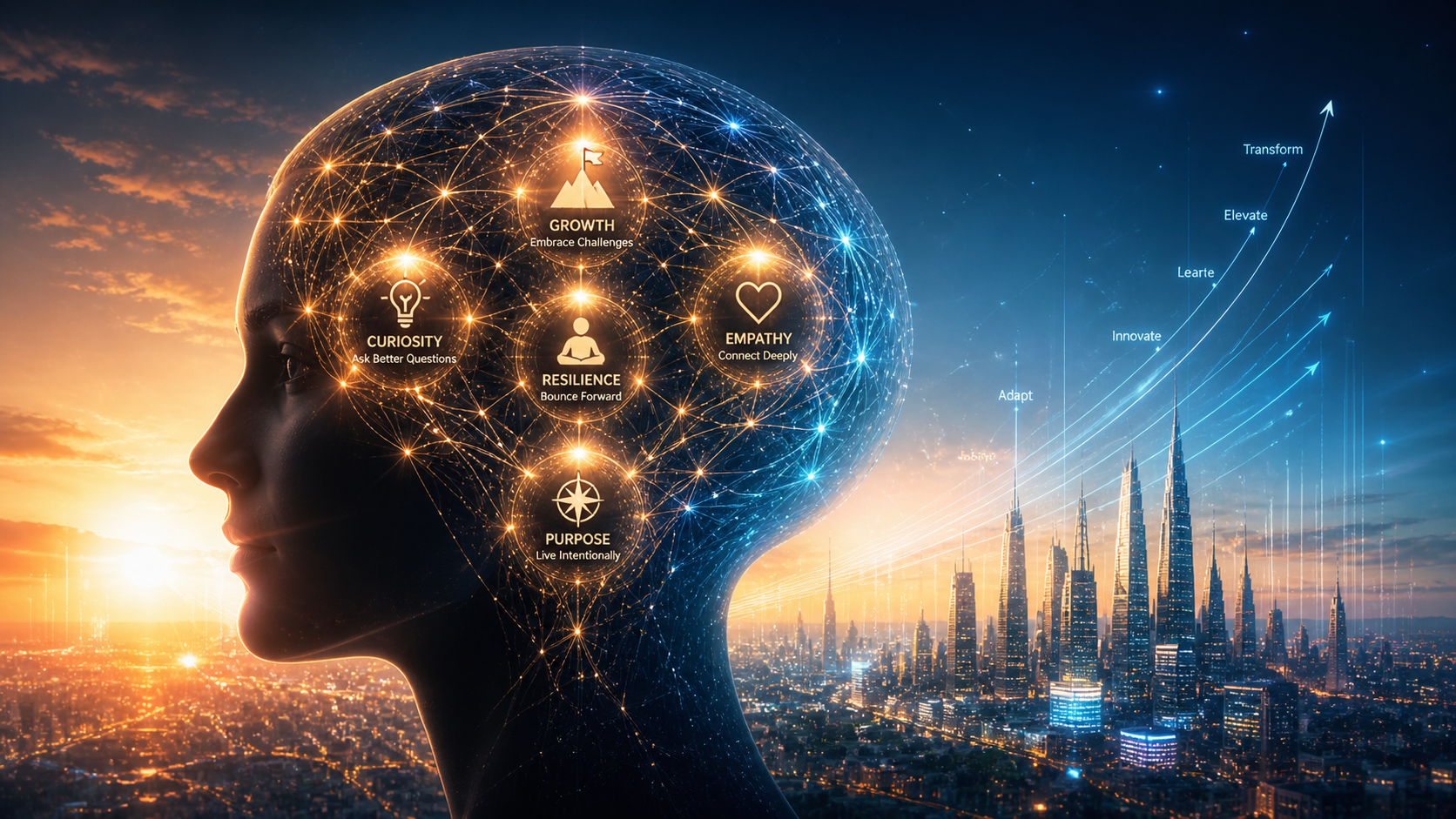
We are living through the most extraordinary period of change in human history. Artificial intelligence, robotics, biotechnology, clean energy, quantum computing — these technologies are not arriving slowly. They are arriving all at once, compounding on each other, and reshaping the world faster than our brains were ever designed to process.
And here lies the great paradox of the 2020s: the tools to transform our lives have never been more powerful, yet the average person — whether sitting in a London boardroom, a Manchester startup, a Birmingham office, or anywhere across the globe — feels more overwhelmed, anxious, and uncertain than ever before.
I’ve spent years studying personal development, entrepreneurship, and the psychology of success. And the more I learn, the more I’m convinced of one truth: technology is not the bottleneck. Mindset is.
Inspired by the work of Peter Diamandis — the visionary behind XPRIZE, Singularity University, and Abundance360 — I want to share with you five mindsets that I believe will determine who thrives and who freezes in the decade ahead. Whether you’re a student in Edinburgh, a founder in Bristol, a professional in Poole (where I now call home), or a dreamer anywhere in the world, these frameworks can be installed, practised, and strengthened.
Let’s dive in.
Why Our Brains Are Struggling to Keep Up
Before we get to the five mindsets, we need to understand the problem.
Our brains evolved over hundreds of thousands of years to survive in a local and linear world. Your great-great-grandfather, whether he was a farmer in Yorkshire, a tradesman in Punjab, or a craftsman in Italy, lived essentially the same life as his great-great-grandfather. Skills, customs, and roles were passed down like genetic code. The future looked like the past.
That world is gone.
We now live in a global and exponential world, where a single tweet can move markets, where ChatGPT went from non-existent to mainstream in 18 months, and where the half-life of a professional skill is collapsing year on year.
Our cognitive filters — the mental shortcuts that once kept us alive — are now misfiring constantly:
- Negativity bias amplifies every threat (and the media, let’s be honest, doesn’t help).
- Confirmation bias locks us into tribal certainties.
- Linear thinking makes us fundamentally incapable of grasping compound, exponential change.
Here’s the good news: mindsets are not fixed personality traits. They are trainable frameworks. You can install them, practise them, and strengthen them — like muscles in a gym.
Here are the five that I believe matter most.
1. Curiosity — The Meta-Skill of the AI Age
Curiosity is the foundational fuel of every great life. It is underpinned by dopamine and designed for discovery. And in a world where AI is fast becoming the ultimate teaching machine — accessible to anyone with a smartphone, from the Highlands of Scotland to the streets of Mumbai — curiosity is the meta-skill that makes every other skill possible.
The professionals I see thriving today are not the ones with the most credentials. They are the ones who refuse to stop pulling on threads. They ask one more question. They take one more course. They read outside their field.
How to practise it this week:
- Dedicate one hour a week to learning something completely outside your domain.
- If you’re in finance, read about biotech. If you’re in marketing, study quantum physics.
- Talk to someone who thinks differently than you do — a different generation, profession, or culture.
- Use AI tools like ChatGPT or Claude as a personal tutor. Ask “explain this to me like I’m ten.”
Britain has a long, proud tradition of curiosity — from Newton to Darwin to Berners-Lee. That tradition lives on in you. Reignite it.
2. Gratitude and Purpose — The Operating System of the Mind
Every morning, I write down three things I am grateful for. It takes five minutes. And it is, without exaggeration, one of the highest-ROI habits in my life.
Why does it work? Because when we feel grateful, we signal safety to our brain. This undercuts the victim mindset and recalibrates the negativity bias — that voice telling you the sky is falling every time you check the news or open your inbox.
A landmark 2019 study published in PNAS tracked thousands of people over three decades and found that optimists live 11 to 15% longer than pessimists. Not because they ignore problems — but because their brains remain functional under stress.
But gratitude alone is not enough. Gratitude without direction is just feeling good. You also need purpose.
Purpose is not a luxury. It is a neurological necessity. It activates the reward system, suppresses the amygdala (where fear lives), and makes flow states accessible. People with purpose recover faster from setbacks, build deeper relationships, and create meaningful work.
Here is the question I want you to sit with this week:
What problem are you solving that is bigger than you?
If you don’t have an answer, your brain is essentially running without an operating system. You’ll be reactive instead of intentional, busy instead of effective.
Find the problem that calls to you. It doesn’t have to be curing cancer. It could be raising remarkable children. Building a business that serves your community. Mentoring the next generation in your town. Purpose is personal — but it must be present.
3. Abundance — Seeing the World as It Truly Is
Our brains evolved in a world of scarcity. They default to threat detection, loss aversion, and zero-sum thinking. Someone else’s gain feels like your loss. This wiring made sense on the savannah. It does not make sense in 2026.
The data tells a radically different story than the headlines:
- Every hour, Earth receives more solar energy than humanity uses in a year.
- AI is making intelligence nearly free.
- Robotics is driving the cost of physical labour towards zero.
- Genome sequencing has dropped from costing £2 billion in 2003 to under £200 today.
- Global extreme poverty has fallen from 36% in 1990 to under 9% today.
Here in Britain, we have a peculiar national talent for pessimism. The “stiff upper lip” is admirable; the “everything’s gone to the dogs” attitude is not. An Abundance Mindset is not naïve optimism. It is a clear-eyed recognition that technology is a resource-liberating mechanism, and that the world — measured by almost any metric — is getting better.
Track the cost curves. Solar energy. Gene sequencing. Compute power. They are all on exponential decline. The opportunities flowing from this are extraordinary, but only if you are looking for them.
This week, try this: For every piece of bad news you consume, force yourself to find one piece of genuine progress happening in the world. Train your brain to see both sides of reality.
4. Exponential and Moonshot Thinking — Aim 10x, Not 10%
Our brains were built for linear extrapolation. Thirty linear steps gets you thirty paces. Thirty exponential steps — doubling each time — gets you past a billion. This is why we consistently underestimate technology in the long run while overestimating it in the short run.
Astro Teller, who runs Alphabet’s X (the “moonshot factory”), discovered something profound: a 10% goal traps you inside existing systems. A 10x goal forces you to throw out the playbook.
If you want to make a car 10% more fuel efficient, you tweak the engine. If you want to make it 10x more efficient, you have to rethink everything — perhaps it’s not a petrol car at all. Perhaps it’s electric. Perhaps it doesn’t need a driver. Suddenly, you’ve created Tesla.
When evaluating any technology or opportunity today, stop asking “How good is it now?” Instead ask:
“What happens when this is 10x better and 10x cheaper?”
That single question, asked in 2020, would have told you AI was about to eat everything.
Here is the question I want you to ponder this week, in your career, your business, your life:
What would you attempt if failure were literally impossible?
Now go attempt it — knowing you will fail repeatedly, and that each failure is just data, not a verdict on your worth.
5. Agency — Life Happens Through You, Not To You
This may be the most important mindset of all.
Agency is the deep conviction that life happens through you, not to you. It is the difference between an internal locus of control (“I shape my destiny”) and an external one (“the world shapes me”).
When you adopt an external locus of control — when you decide AI is an unstoppable wave crashing on your head, that the economy is too tough, that “the system” is rigged against you — your brain literally powers down the prefrontal cortex and enters a state psychologists call learned helplessness.
Agency reverses that cascade. It keeps the creative, problem-solving brain online. It transforms every challenge from a threat into a puzzle.
Research consistently shows that people with a strong sense of agency experience less depression, greater resilience, and faster recovery from setbacks — even when facing identical external circumstances to people who crumble.
In Britain, we sometimes inherit a quiet fatalism — a sense that life simply happens to us, that promotions are doled out, that opportunities arrive (or don’t). I want you to push back firmly against that.
Every morning, identify one thing you can control today. Not what the markets do. Not what the government announces. Not what your boss decides. Not what OpenAI releases. What YOU do.
Start there. Build from there. Your agency is your superpower.
The Real Bottleneck Is Not Out There — It Is In Here
The tools of this decade are extraordinary. AI tutors smarter than any private school teacher. Healthcare diagnostics that can spot cancer years before symptoms appear. Energy solutions that could power humanity sustainably forever. Educational resources, once locked behind elite university walls, now available free on a smartphone in Sunderland or São Paulo.
The technology is here. The question is whether you will pick it up.
The five mindsets we’ve explored — Curiosity, Gratitude and Purpose, Abundance, Exponential Thinking, and Agency — are not abstract theory. They are the operating system upgrades your brain needs to navigate this decade with confidence and clarity.
You don’t need to install all five at once. Pick one. Start tomorrow morning. Write down three things you’re grateful for. Or ask a stranger an honest question. Or identify the one moonshot you’ve been afraid to admit you want to attempt.
Small daily actions, compounded exponentially, create extraordinary lives.
I genuinely believe we are living in the most exciting decade in human history. The question is not whether the future will be different. It will be. The question is whether you will shape it — or be shaped by it.
Choose to shape it.
To a future of abundance, agency, and remarkable lives…
 Darpan Sachdeva is the CEO and Founder of Nobelthoughts.com. Driven by a profound dedication to Entrepreneurship, Self-development, and Success over an extended period, Darpan initiated his website with the aim of enlightening and motivating individuals globally who share similar aspirations. His mission is to encourage like-minded individuals to consistently pursue success, irrespective of their circumstances, perpetually moving forward, maintaining resilience, and extracting valuable lessons from every challenge.