by Darpan Sachdeva
Friends, I’m writing this with a mixture of exhilaration and urgency that I haven’t felt in years. What I’m about to share with you isn’t just another tech trend or business prediction. This is the blueprint of a future that’s arriving faster than most of us are prepared for—a future that will either elevate you to heights you’ve never imagined or leave you wondering what happened while you were following the old playbook.
We’re standing at the threshold of what I call “Hyperabundance”—a world where artificial intelligence and robotics will produce so much value, create so many services, and solve so many problems that we’ll literally run out of tasks to assign them. Imagine an economy growing one thousand times larger than what we have today. Not ten times. Not a hundred times. One thousand times.
Think about that for a moment. When growth reaches that magnitude, we’ll have already saturated every conceivable human want and need. This isn’t science fiction, my friends. This is the trajectory we’re on right now, and it’s accelerating.
The Trillion-Dollar Operating System of Everything
Let me share something that should make every entrepreneur, every investor, and every forward-thinking professional sit up straight. NVIDIA, the company that makes the processors powering our AI revolution, is projecting to reach one trillion dollars in revenue by 2027. Not market capitalization. Revenue.
To put this in perspective, their recent conference drew thirty thousand attendees to a stadium. Not a convention center—a stadium. When in history have customers literally begged vendors for products, pleading to give them money? That’s the reality we’re living in right now.
But here’s what truly blows my mind: NVIDIA isn’t just selling chips anymore. They’re positioning themselves as the operating system for everything—autonomous vehicles, humanoid robots, orbital data centers, even physical AI systems operating in space. This is comparable to Microsoft in the PC era or Google in the search era, but exponentially bigger. We’re talking about NVIDIA inside everything.
The bottleneck?
Manufacturing capacity. They’ve already locked up seventy percent of the world’s most advanced three-nanometer chip production capacity. The demand is so overwhelming that production, not desire, is the limiting factor.
The Battle for AI Supremacy: A Masterclass in Strategy
Here’s a stunning development that every business leader needs to understand. In just three months, Anthropic has surged from forty percent market share to seventy-three percent in enterprise AI. Meanwhile, their competitor OpenAI dropped from sixty percent to twenty-six percent in the same period.
This isn’t just a shift. This is an absolute transformation of the competitive landscape, and it teaches us something profound about strategy.
One company bet big on consumers, thinking individuals would pay premium prices for advanced AI reasoning. That bet failed. Why? Because consumers use AI to check sports scores and get recipe ideas. Enterprises use AI to automate entire departments and transform business models.
Here’s the brutal truth: twenty dollars a month from a consumer is a nice-to-have subscription. Two hundred dollars per employee per month to a company facing existential disruption? That’s mandatory spending. That’s survival.
The company that recognized this reality—Anthropic—is now generating billions in monthly revenue and is on track to dominate the enterprise AI market by the end of next year. Their AI coding tool alone generated two and a half billion dollars in revenue in a single month.
The lesson?
Don’t just chase the biggest market. Chase the market where your solution is existential, not optional.
“The future belongs not to those who predict it, but to those who build it with courage, adaptability, and an unwavering commitment to solving problems that matter.”
The Chip Factory That Could Change Geopolitics
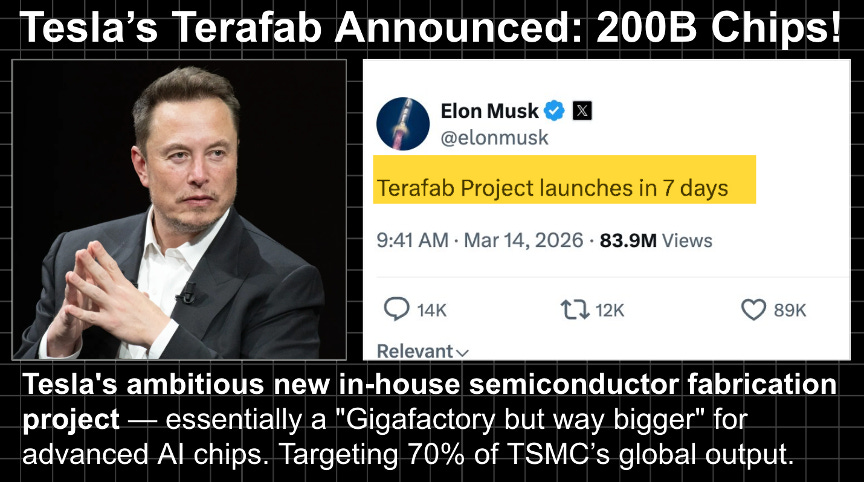
Just when you think the pace of innovation couldn’t accelerate further, here comes another game-changing development. Plans are underway for a semiconductor mega-factory in the United States that would produce chips at a scale equaling roughly seventy percent of the world’s largest chip manufacturer’s entire global output—from a single facility.
Why would anyone undertake something this audacious? Vertical integration and strategic independence.
When you need chips for autonomous vehicles, humanoid robots, and massive AI supercomputers, you don’t want to depend on anyone else’s supply chain. You build your own.
But there’s a larger implication here that affects all of us: energy security and technological sovereignty. If the West can scale independent semiconductor production at this level, we dramatically reduce our vulnerability to global supply chain disruptions. This is how visionary entrepreneurs think—they don’t just build businesses; they reshape the strategic landscape for entire nations.
The Energy Revolution Hiding in Plain Sight
Here’s something flying under most people’s radar: we’re experiencing a nuclear power renaissance, and AI is the catalyst making it politically possible.
Financial institutions are projecting an energy shortfall of up to forty-four gigawatts for data centers through 2028. Translation: we need massive amounts of clean, reliable energy, and we need it fast.
Suddenly, nuclear is back in style. Regions that banned large nuclear reactors are lifting restrictions. Tech giants are securing gigawatts of clean power through partnerships with next-generation nuclear companies. Japan has restarted the world’s largest nuclear power plant. Companies are deploying floating small modular reactors offshore.
What changed? AI became the political cover for getting nuclear back online. It’s no longer framed as a climate debate. Now it’s “we need AI to compete globally, therefore we need nuclear power.” All barriers are falling. All handcuffs are off.
We’re about to speed-run all the nuclear advancement that should have happened from the 1970s through today. AI is the excuse, but the result is we’re finally building the energy infrastructure humanity should have had decades ago.
The Wake-Up Call Every Parent, Student, and Professional Needs to Hear
Now we arrive at the part that should shake every single one of us out of complacency. I’m an advocate for education transformation, and what I’m about to share represents a personal wake-up call for anyone invested in the future.
A computer science professor recently shared placement data from his program over the last three years. Fall 2023: eighty-nine percent of students placed with an average salary of ninety-four thousand dollars. This spring: nineteen percent placed at an average salary below sixty-one thousand dollars.
Let that sink in. These students invested years and tens of thousands of dollars in degrees for careers that evaporated while they were in class.
And this isn’t just computer science. We’re going to see this same collapse across medicine, law, accounting—every knowledge work profession.
Here’s what happened: roughly six years ago, platforms like GitHub introduced peer-to-peer code review and rating systems. Suddenly, your salary in the tech industry had nothing to do with your university, your degree, or your grades. It became one hundred percent based on your demonstrated capability rating. A peer-to-peer meritocracy completely replaced top-down credentialing. Traditional computer science degrees lost their value that day.
The Old Social Contract Is Dead: Here’s the New One
The traditional path that our parents followed and that many are still pushing their children toward—do well in high school, go to a prestigious college, get a degree, land a job—is finished. It’s done. It’s cooked.
So what’s the new path? It looks radically different:
Find your purpose and passion. Shape your mindset for resilience and continuous learning. Become an expert in a problem space that matters. Become an entrepreneur or join a startup team. Create your own future. Transform yourself from a consumer into a creator.
Most importantly: get on cap tables. Become a shareholder, not just a wage earner.
What This Means for India, Europe, the UK, the US, and the Global Economy
This transformation isn’t limited to Silicon Valley. India’s technology sector, already a global powerhouse, has the opportunity to leapfrog traditional industrial development entirely. With the right mindset shift, Indian entrepreneurs and technologists can build AI-first companies that serve global markets from day one.
Europe, with its strong educational institutions and growing startup ecosystem, needs to embrace this shift away from credentialism toward capability demonstration. The European emphasis on engineering excellence positions the continent perfectly for the AI revolution—if the regulatory environment can keep pace.
The United Kingdom, with its historical strength in research and innovation, can reclaim technological leadership by fostering environments where young people pursue mastery and entrepreneurship rather than just degrees.
The United States, despite challenges, maintains advantages in risk capital, entrepreneurial culture, and technology infrastructure that position it well for this transition—but complacency will be fatal.
Developing economies worldwide have an unprecedented opportunity. When the cost of intelligence approaches zero and the tools of creation become universally accessible, geography becomes far less relevant than mindset and initiative.
Your Action Plan for the Age of Hyperabundance
If you’re an entrepreneur, start reimagining how agent-to-agent workflows will replace human-to-human processes in your industry. That’s where the transformation is happening. That’s the unlock.
If you’re a student or early in your career, don’t mortgage your future for a degree in a field that’s being automated. Find a problem you genuinely care about solving, and use AI as your superpower to solve it. Build your portfolio of demonstrated capabilities. Make yourself valuable by creating value.
If you’re a parent, have honest conversations with your children about the world they’re entering. Show them the employment data. Help them understand that the path isn’t school to job anymore. It’s passion to problem to startup to ownership.
If you’re a professional in a knowledge work field, recognize that your expertise needs to evolve from doing the work to orchestrating AI systems that do the work. Your value shifts from knowledge holder to problem solver, from task executor to strategic thinker.
The Supersonic Tsunami Is Here
We’re not heading toward a future of abundance. We’re already in it. The question isn’t whether this transformation will happen—it’s happening right now. The only question is whether you’ll be swept away by it or learn to ride it.
This is the most exciting, terrifying, and opportunity-rich moment in human history. A thousand-fold economic expansion isn’t just about more stuff. It’s about liberating human potential from drudgery and scarcity, allowing us to focus on creativity, connection, and contribution at levels we’ve never imagined.
But that future isn’t automatic. It requires us to let go of old maps that no longer match the territory. It demands we embrace uncertainty as the price of possibility. It insists we become learners, builders, and creators rather than passive consumers of education and employment.
The choice is yours. The old path offers the comfort of familiar failure. The new path offers the discomfort of unprecedented possibility.
Which will you choose?
The future isn’t something that happens to us. It’s something we create, one bold decision at a time. And right now, in this moment of hyperabundance dawning before us, your decisions matter more than ever.
Let’s build something extraordinary together.
 Darpan Sachdeva is the CEO and Founder of Nobelthoughts.com. Driven by a profound dedication to Entrepreneurship, Self-development, and Success over an extended period, Darpan initiated his website with the aim of enlightening and motivating individuals globally who share similar aspirations. His mission is to encourage like-minded individuals to consistently pursue success, irrespective of their circumstances, perpetually moving forward, maintaining resilience, and extracting valuable lessons from every challenge.