by Darpan Sachdeva
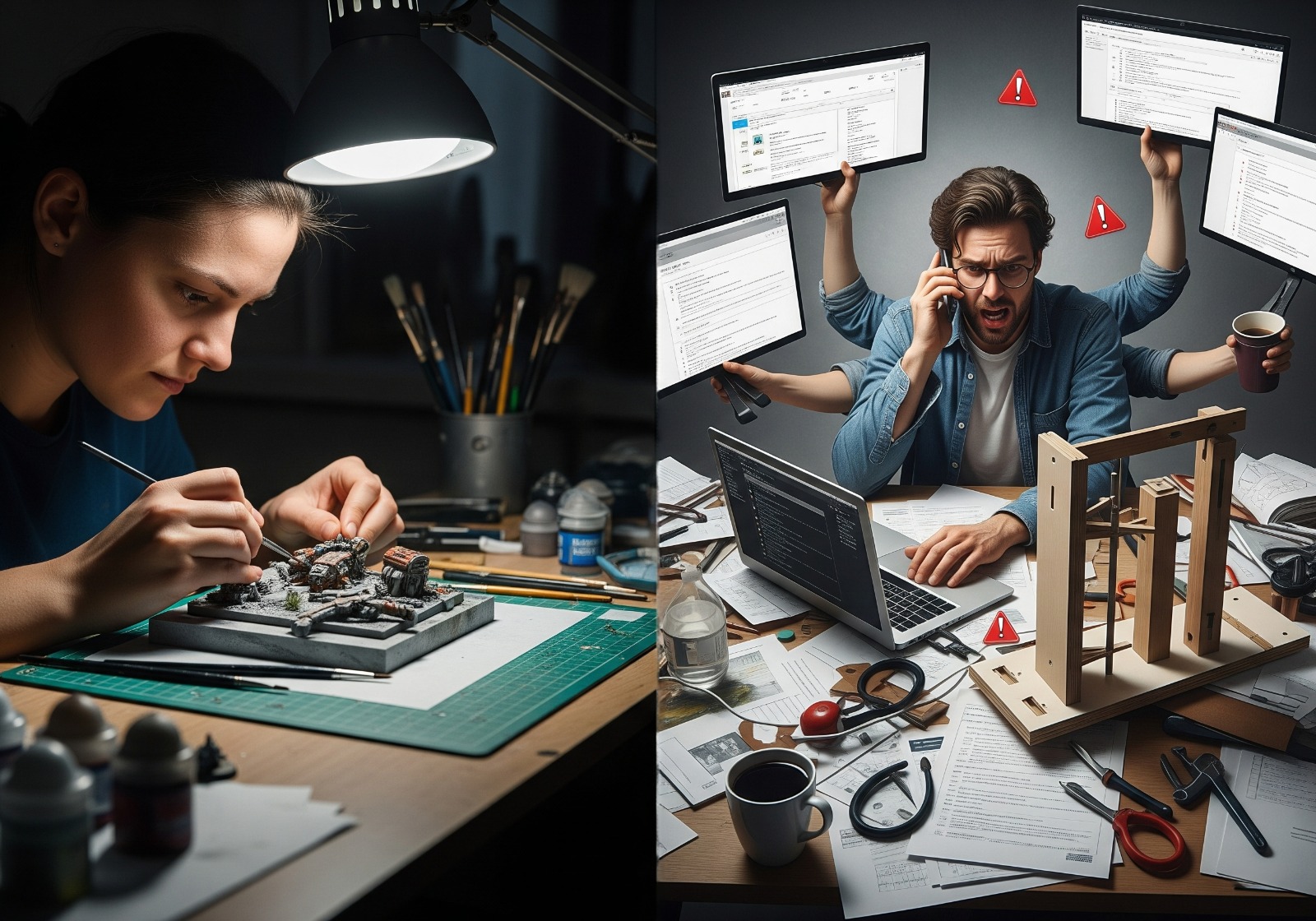
Last Tuesday morning, I found myself in a familiar scene that probably mirrors your own daily reality. My laptop displayed seventeen browser tabs, my phone buzzed with notifications every thirty seconds, and I was simultaneously trying to write a marketing strategy for one of my e-commerce stores while responding to client emails for my digital marketing company. I felt busy, productive even. I was getting things done, or so I thought.
Then I looked at my actual output for the day. Despite being “busy” for eight straight hours, I had completed exactly zero meaningful tasks. Not one. The marketing strategy remained half-finished, important emails went unanswered, and my personal development blog post deadline loomed larger than ever.
That moment of brutal honesty forced me to confront a truth that most entrepreneurs refuse to acknowledge: our obsession with multitasking isn’t making us more productive—it’s systematically destroying our ability to create anything of value.
The Multitasking Myth That’s Ruining Everything
Here’s what the research tells us, and it’s more damaging than you might think. Stanford University conducted a comprehensive study on heavy multitaskers, expecting to find that people who juggle multiple tasks simultaneously would excel in at least one area of cognitive function. Instead, they discovered something shocking: heavy multitaskers performed worse on every single measure.
They couldn’t filter out irrelevant information. They couldn’t manage their working memory effectively. Most surprisingly, they were even terrible at multitasking itself. The very thing they thought they were good at was actually their biggest weakness.
Dr. Clifford Nass, who led the research, put it bluntly: “Multitaskers are terrible at every aspect of multitasking.” This isn’t just an academic observation—it’s a productivity disaster affecting millions of people who believe they’re optimizing their performance.
But the real kicker comes from neuroscience research at the University of California, Irvine. Professor Gloria Mark discovered that after an interruption, it takes an average of 23 minutes and 15 seconds to fully refocus on the original task. Twenty-three minutes. Think about how many interruptions you experience in a typical day, and you’ll start to understand why that marketing strategy never got finished.
The Hidden Cost of Mental Gymnastics
When I was juggling my digital marketing clients, managing inventory for my e-commerce stores, and trying to build my personal development company, I thought I was being efficient. In reality, I was engaged in what researchers call “task-switching,“ and it was costing me more than I ever imagined.
Every time you shift your attention from one task to another, your brain has to perform what scientists call a “cognitive gear change.” It’s like driving a car and constantly shifting between first and fifth gear. The engine works harder, consumes more fuel, and eventually breaks down faster. Your brain operates the same way.
This constant mental gear-changing doesn’t just slow you down—it exhausts your cognitive resources. By the end of a multitasking-heavy day, your brain is so depleted that you can’t make good decisions, think creatively, or maintain the energy needed for your most important work.
I experienced this firsthand during the early days of my entrepreneurial journey. I would end each day feeling completely drained, despite not having accomplished anything meaningful. I was busy, but not productive. Active, but not effective. The difference, I discovered, lies in the power of single-tasking.
The Single-Task Revolution: A Return to Human Nature
Here’s the counterintuitive truth that transformed my entire approach to work: doing one thing at a time isn’t limiting—it’s liberating. It’s not slower—it’s dramatically faster. And it’s not less efficient—it’s the most efficient way humans can operate.
Our brains evolved to focus intensely on one task at a time. For thousands of years, this singular focus meant the difference between survival and death. When our ancestors were hunting, they couldn’t afford to think about gathering berries. When they were escaping a predator, they couldn’t multitask their way to safety.
Yet somehow, in the past few decades, we’ve convinced ourselves that we’ve evolved beyond these fundamental limitations. We haven’t. Our brains still operate best when focused on a single task, and the sooner we align our work habits with this biological reality, the sooner we’ll unlock our true productive potential.
The single-task revolution isn’t about doing less—it’s about doing what matters with the full force of your cognitive abilities. It’s about giving your best work the attention it deserves, rather than dividing your mental resources among tasks that ultimately suffer from your scattered focus.
How I Transformed My Productivity With Single-Tasking
The transformation didn’t happen overnight, but the results were immediately noticeable. I started by implementing what I call the “One Thing Protocol.” Every morning, I identify the single most important task that will move my business forward. Everything else gets scheduled for later or eliminated entirely.
For instance, instead of trying to write blog content while monitoring my e-commerce store metrics and responding to client messages, I dedicate the first two hours of my day exclusively to writing. No phone, no notifications, no browser tabs except the one containing my writing document. The result? I now produce higher-quality content in half the time it used to take.
This principle extends to all areas of my business. When I’m working on digital marketing strategies for clients, that’s all I do. When I’m analyzing data for my e-commerce stores, I close everything else. When I’m developing personal development content, I give it my complete attention.
The compound effect of this approach has been remarkable. Tasks that previously took me entire days to complete now get finished in hours. More importantly, the quality of my work has improved dramatically because I’m bringing my full cognitive capacity to each task.
The Ripple Effect of Deep Focus
What surprised me most about embracing single-tasking wasn’t just the immediate productivity gains—it was the unexpected benefits that emerged over time. When you train your brain to focus deeply on one task, you develop what researchers call “cognitive endurance.” Your ability to maintain concentration improves, your creative thinking sharpens, and your problem-solving skills become more sophisticated.
I started noticing patterns and connections in my work that I had previously missed. Marketing strategies became more nuanced and effective. Content creation flowed more naturally. Business decisions were made with greater clarity and confidence. These weren’t just productivity improvements—they were qualitative leaps in the caliber of my thinking and output.
The personal transformation extended beyond work. My stress levels decreased significantly because I was no longer constantly anxious about the dozen tasks competing for my attention. My confidence grew as I began completing meaningful projects rather than just staying busy. Most importantly, I rediscovered the satisfaction that comes from deep, focused work—something that had been missing from my entrepreneurial journey.
The Science of Sustained Attention
Recent neuroscience research reveals why single-tasking is so effective. When you maintain focus on one task for extended periods, your brain enters what scientists call a “state of flow.” In this state, the prefrontal cortex—the part of your brain responsible for self-criticism and anxiety—actually downregulates, allowing for enhanced creativity and performance.
Dr. Arne Dietrich’s research on transient hypofrontality shows that during deep focus, your brain optimizes itself for the task at hand. Irrelevant neural networks quiet down, while the networks essential for your current work become hyperactive. It’s like having a spotlight instead of a floodlight—you see less, but what you see is illuminated with remarkable clarity.
This explains why my best marketing strategies, most engaging blog posts, and most innovative business ideas now emerge during periods of sustained single-tasking. My brain isn’t fighting against its natural design—it’s working with it.
Breaking Free From the Multitasking Trap
The transition to single-tasking requires rewiring habits that have become deeply ingrained in our work culture. The constant ping of notifications, the cultural badge of honour associated with being “busy,” and the fear that we’re missing something important all conspire to pull us back into multitasking mode.
I’ve learned that successful single-tasking starts with environmental design. I now use apps that block distracting websites during focused work sessions. My phone goes into airplane mode for predetermined periods. I’ve trained my team and clients to expect delayed responses during my deep work blocks, and remarkably, this has improved rather than harmed these relationships.
The key insight is that availability and productivity are often inversely related. The more available you are to interruptions, the less productive you become. The less available you are during focused work periods, the more valuable you become to everyone who depends on your output.
A Different Kind of Success
As I write this, I’m practicing exactly what I’m preaching. This blog post has my complete attention. No notifications are interrupting my flow. No other browser tabs are tempting me to multitask. The result is content that I’m genuinely proud of—content that I couldn’t have created while juggling multiple tasks.
This represents a fundamental shift in how I define productivity. It’s not about how many tasks I can juggle simultaneously or how busy I appear to others. It’s about the depth and quality of the work I produce when I give it my full attention.
The single-task revolution isn’t just a productivity technique—it’s a return to human nature. It’s an acknowledgment that our brains, despite all their remarkable capabilities, work best when focused on one thing at a time. It’s a rejection of the modern myth that more is always better, and an embrace of the timeless truth that depth beats breadth every time.
For a deeper dive into the neuroscience behind why multitasking fails and how single-tasking transforms performance, I recommend watching this insightful video:

The research presented will reinforce everything we’ve discussed and provide additional strategies for implementing these principles in your own work.
The choice is yours. You can continue to fragment your attention across multiple tasks, remaining busy but rarely productive. Or you can join the single-task revolution and discover what your mind is truly capable of when you give it the focus it deserves.
The revolution starts with your next task. Choose one thing. Give it everything you have. And watch as your productivity, creativity, and satisfaction with your work reach levels you never thought possible.
 Darpan Sachdeva is the CEO and Founder of Nobelthoughts.com. Driven by a profound dedication to Entrepreneurship, Self-development, and Success over an extended period, Darpan initiated his website with the aim of enlightening and motivating individuals globally who share similar aspirations. His mission is to encourage like-minded individuals to consistently pursue success, irrespective of their circumstances, perpetually moving forward, maintaining resilience, and extracting valuable lessons from every challenge.