by Darpan Schdeva
“We are not just witnessing the future – we are living at the exact moment when science fiction becomes science fact, where the impossible transforms into the inevitable.”
Friends, I just emerged from one of the most mind-bending conversations I’ve experienced in months. Listening to Peter Diamandis, Dave Blundin, Salim Ismail, and Dr. Alexander Wissner-Gross discuss the latest AI developments felt like getting a glimpse into tomorrow’s newspaper today. What they revealed isn’t just exciting – it’s absolutely revolutionary.
As I sat in my home, absorbing every word of their analysis, one truth became crystal clear: we’re not approaching a technological revolution anymore. We’re already living inside one, and most of us haven’t even realized it yet.
When Magic Becomes Reality
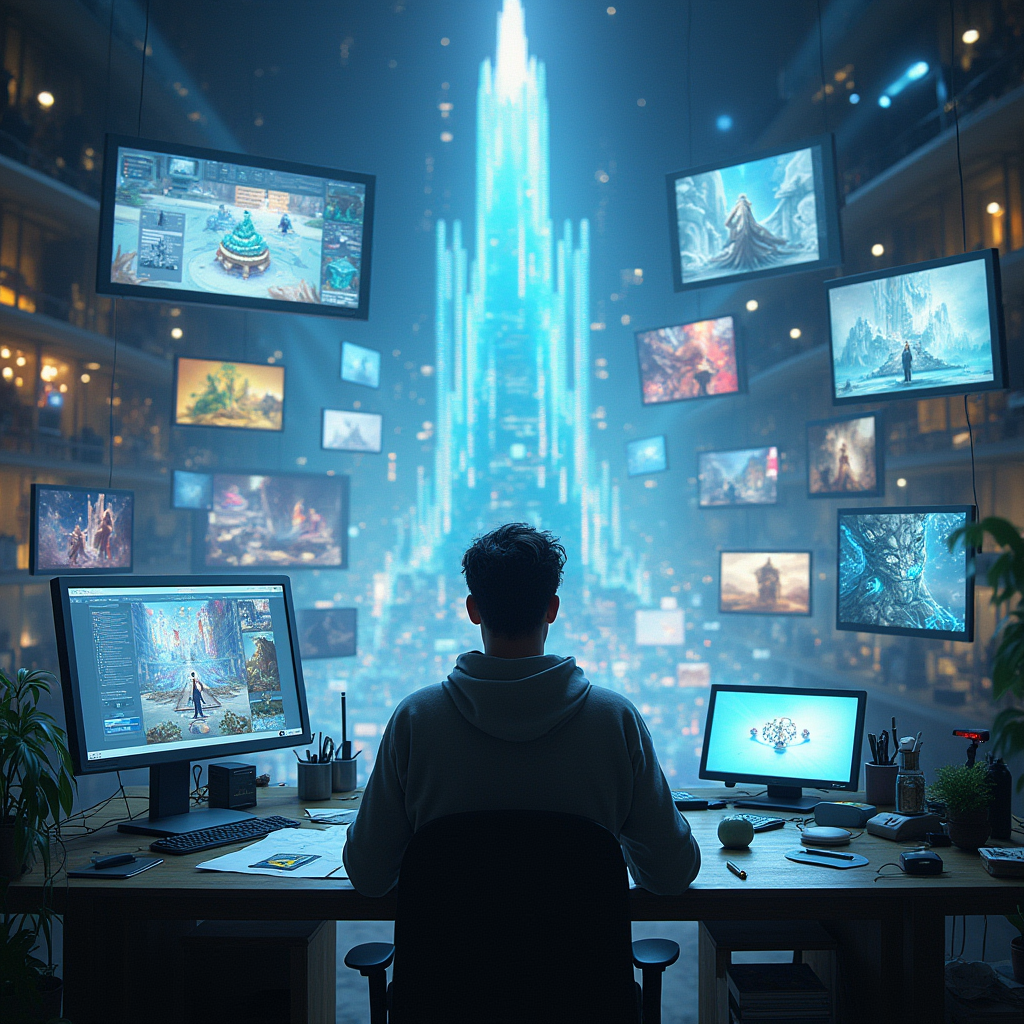
Let me paint you a picture that would have been pure fantasy just twelve months ago. Today, I can speak a single sentence into my phone and watch as artificial intelligence creates a Hollywood-quality video of myself having conversations on the moon, pumping weights in a gym, or sitting down with Sam Altman for an interview. The technology that creates this isn’t locked away in some billion-dollar studio – it’s free, accessible to anyone with a smartphone.
This isn’t about incremental improvements anymore. We’re witnessing what the experts call “the transition from algorithmic content selection to algorithmic content generation.” Think about that for a moment. We’ve moved beyond AI simply choosing what content to show us – now AI is creating the content itself, from scratch, in real-time.
Meta’s new Vibes app, powered by partnerships with MidJourney and Black Forest Labs, represents something profound. Here’s a company worth hundreds of billions of dollars, with unlimited resources, yet they’re partnering with startups to deliver cutting-edge video generation. Why? Because the pace of innovation has become so intense that even tech giants can’t keep up internally. The creative brilliance is flowing from small, agile teams who dare to dream differently.
The Mathematics of Impossibility
But here’s where it gets truly extraordinary. We’re not just talking about pretty videos or clever tricks. AI systems like Claude Sonnet 4.5 are now working autonomously for over thirty hours straight, writing complex code, solving problems, and creating entire applications in real-time. Remember when we celebrated AI that could work for one hour independently? That was mere months ago.
Dr. Wissner-Gross revealed something that sent chills down my spine: AI is on the verge of solving mathematics itself. Not just individual problems, but the entire process of mathematical reasoning. When that happens – and he predicts it’s months, not years away – we’ll see a cascading effect across every field that depends on mathematical thinking. Cryptography, economics, physics, engineering – all could fall in rapid succession.
This is the moment when everything we thought we knew about timelines gets thrown out the window. We’re not experiencing gradual, linear progress. We’re riding an exponential curve that’s accelerating into something resembling magic.
The Energy Revolution Hidden in Plain Sight
One of the most powerful segments of their discussion focused on something that perfectly illustrates our cognitive blindness to exponential change. Solar energy has grown from 40 gigawatts to nearly 3 terawatts in just fifteen years – a 75x increase. Yet year after year, the world’s top energy experts predicted it would level off, go flat, even decline.
This isn’t a math error – it’s a cognitive error. Even the smartest people in their fields consistently fail to grasp exponential growth. The same pattern played out with mobile phones, where experts predicted modest growth while reality delivered 100% year-over-year increases.
Here’s what this means for you: every industry you think is stable, every assumption you hold about what’s possible, every limitation you accept as permanent – question all of it. The impossible is becoming inevitable at a pace that defies our ability to process it.
The Democratization of Superpowers
What excites me most is how these technologies are being democratized. For eight dollars a month, you can access AI music composition tools that rival Hans Zimmer. Free video generation tools are creating content indistinguishable from professional studios. Voice AI is creating conversations so realistic they pass every test we can devise.
This isn’t just about entertainment or convenience. This represents the greatest leveling of the playing field in human history. A teenager in rural India now has access to the same creative and analytical tools as a Fortune 500 company. A small business owner in Manchester can compete with global corporations using AI assistants that never sleep, never tire, and continuously learn.
The barriers that separated the possible from the impossible, the affordable from the exclusive, are crumbling before our eyes.
Investing in Tomorrow’s Reality

From an investment perspective, we’re witnessing the birth of entirely new categories of value creation. Companies are achieving billion-dollar valuations not over decades, but in months. Young founders like 24-year-old Karina Hong are raising $64 million at $300 million valuations to build AI mathematicians. Twenty-three-year-old Brendan Foody is racing toward becoming the youngest billionaire since Mark Zuckerberg.
But here’s the deeper insight: we’re not just investing in companies anymore. We’re investing in the fundamental reorganization of reality itself. The old rules about what requires human intelligence, what takes time to create, what costs money to produce – all of these assumptions are being rewritten simultaneously.
Intel’s recent 80% surge in six weeks wasn’t just a stock play – it represented America’s recognition that semiconductor sovereignty is national security. When governments start thinking in venture capital terms, when sovereign nations begin acting like startup accelerators, you know the game has fundamentally changed.
The Human Element in an AI World
Yet amid all this technological marvel, the human element becomes more precious, not less. While AI can generate infinite content, create perfect mathematics, and solve complex problems, it’s human creativity, human judgment, and human values that guide these tools toward meaningful outcomes.
Jensen Huang’s observation that we need more electricians and plumbers in our AI-powered world isn’t contradictory – it’s prophetic. As digital intelligence handles the abstract and the virtual, human skills in the physical world become more valuable. The young people choosing trade schools over universities aren’t falling behind – they’re positioning themselves for the future.
The Longevity Revolution
Perhaps most personally meaningful is the convergence of AI with longevity science. Chinese researchers have successfully modified the FOXO3 gene to reduce aging by three to five years. David Sinclair‘s epigenetic reprogramming trials are moving into human testing. The same AI systems solving mathematics and creating videos are now being trained on the biology of aging itself.
The experts I trust most believe we’ll see significant breakthroughs in human lifespan extension by 2030 – the same timeline AI models predict for achieving artificial general intelligence. This isn’t coincidence; it’s convergence. The tools that are revolutionizing technology are simultaneously revolutionizing biology.
Your Role in Tomorrow’s Story
Here’s what all of this means for you, whether you’re an entrepreneur, an employee, a student, or simply someone trying to understand where the world is heading: we’re living through the most extraordinary transformation in human history, and your choices in the next few years will determine whether you ride the wave or get swept away by it.
Don’t wait for perfect understanding before you begin experimenting with these tools. Don’t assume the experts know what’s impossible. Don’t believe that exponential change will somehow slow down to accommodate our comfort zones.
Instead, embrace the mindset of exponential possibility. Start experimenting with AI tools today. Question every assumption about what your industry, your job, your life could look like in two years. Most importantly, remember that in a world where artificial intelligence can do almost anything, human wisdom, creativity, and values become infinitely more precious.
The future isn’t coming – it’s here. The question isn’t whether these changes will affect you – it’s whether you’ll help shape them or simply react to them.
We are living at the dawn of the age of digital gods, where human intention combined with artificial intelligence creates possibilities limited only by our imagination and courage to pursue them.
The extraordinary is no longer extraordinary. It’s Tuesday.
And that, my friends, is the most extraordinary thing of all.
What exponential change are you witnessing in your field that others might be missing? Share your observations – together, we can better navigate this incredible transformation.
Watch this fascinating discussion on exponential growth and AI development:

Remember: In a world changing this rapidly, the biggest risk isn’t taking chances on the impossible – it’s assuming the possible is all there is.
 Darpan Sachdeva is the CEO and Founder of Nobelthoughts.com. Driven by a profound dedication to Entrepreneurship, Self-development, and Success over an extended period, Darpan initiated his website with the aim of enlightening and motivating individuals globally who share similar aspirations. His mission is to encourage like-minded individuals to consistently pursue success, irrespective of their circumstances, perpetually moving forward, maintaining resilience, and extracting valuable lessons from every challenge.